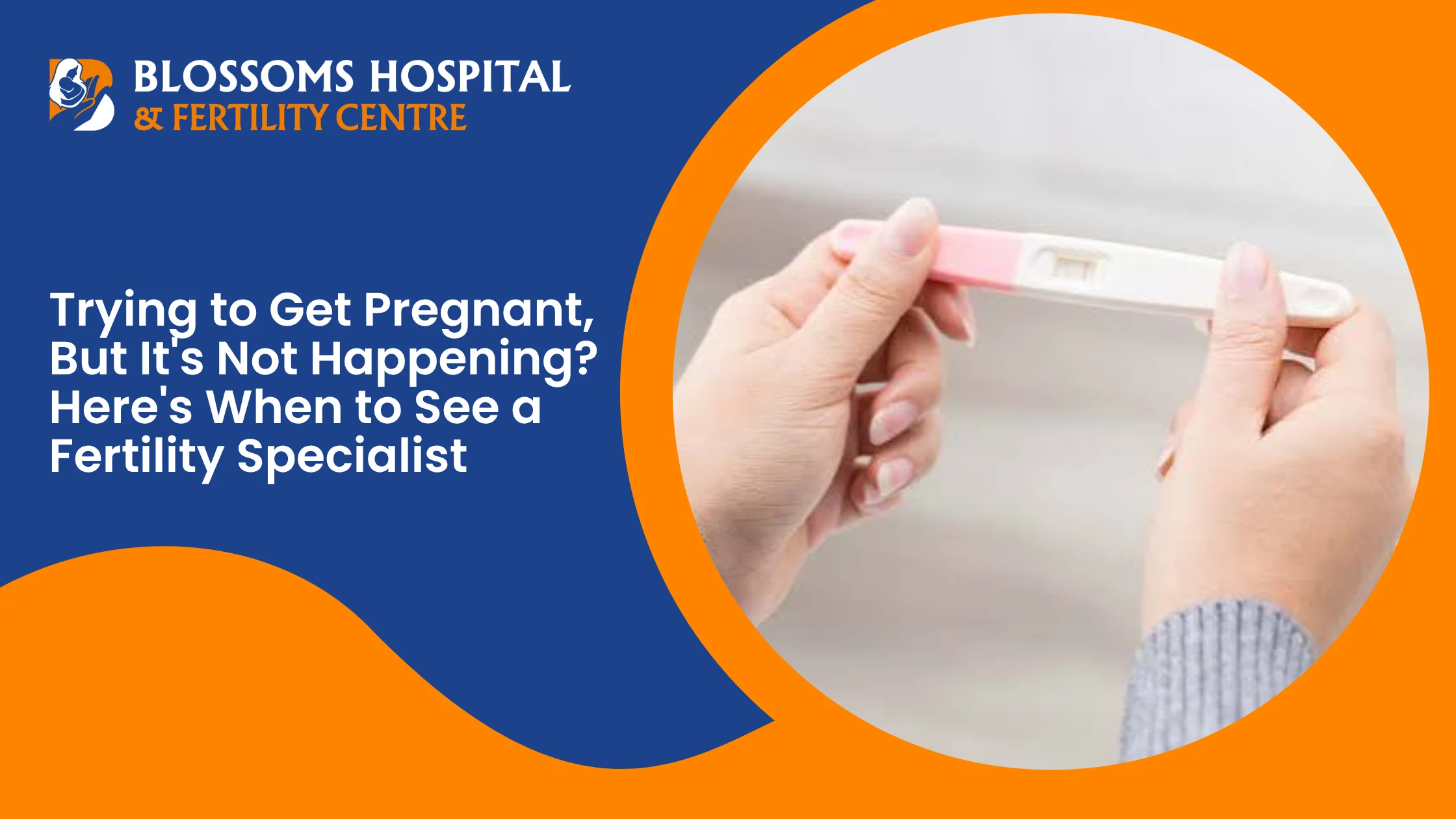
One month, you’re hopeful.
The next month, you’re checking the calendar again.
You notice that your period is late. You try not to get too excited, but somewhere in your mind, you’ve already started wondering if this could be the month.
Then your period arrives.
You tell yourself, “It’s okay. Maybe next month.”
But after a few months, that same thought starts feeling a little heavier.
Someone in the family asks when you’re planning to have a baby. A friend announces her pregnancy. You smile, congratulate her, and later find yourself wondering why things are taking longer for you.
And eventually, there’s a question you may not know how to answer.
“We’ve been trying for a baby. How long should we wait before seeing a doctor?”
The answer depends on your age, health, and how long you’ve been trying.
Let’s understand when it’s time to seek help and what actually happens when you visit a fertility specialist.
How Long Does It Normally Take to Get Pregnant?
Getting pregnant doesn’t always happen in the first month.
Even when both partners are healthy, it can take time. Pregnancy depends on several things happening together, including the release of an egg, healthy sperm, the timing of intercourse, and the condition of the reproductive organs.
Not getting pregnant after two or three months doesn’t automatically mean something is wrong.
But there is a point when speaking to a doctor becomes important.
If the woman is under 35 and has been trying for 12 months without success, a fertility evaluation is usually recommended.
If she is 35 or older, it’s generally better to seek advice after six months.
For women over 40, seeking guidance sooner may be helpful.
These are general recommendations. Certain health concerns may mean you should see a doctor earlier.
Are There Signs That You Shouldn’t Wait?
Sometimes, waiting for six months or a year isn’t necessary.
For example, you may have noticed that your periods have never been regular. Some months, they arrive on time. Other months, they’re delayed by several weeks.
Or perhaps you’ve already been diagnosed with PCOS or endometriosis.
These conditions can sometimes affect the chances of getting pregnant, although having one doesn’t automatically mean you will have difficulty conceiving.
You should consider an earlier consultation if:
- Your periods are very irregular or absent.
- You have a history of endometriosis or problems with your fallopian tubes.
- You have had a pelvic infection or surgery that may affect fertility.
- Either partner has a known fertility concern.
- Either partner has undergone treatment such as chemotherapy that may affect fertility.
You don’t need to wait until you’ve tried every home remedy or followed every piece of advice you’ve heard.
Sometimes, an early consultation can help you understand what needs attention.
“My Periods Are Regular. Doesn’t That Mean Everything Is Fine?”
Regular periods are generally a reassuring sign that ovulation may be happening.
But they don’t tell us everything about fertility.
A woman may have regular menstrual cycles and still have other factors affecting pregnancy, such as problems with the fallopian tubes.
And fertility isn’t only about the woman.
Sperm count, movement, and other factors can also affect the chances of conception.
This is why fertility evaluation often involves both partners.
It’s common for women to feel that they should undergo all the tests first. But when both partners are contributing to a pregnancy, checking both at the beginning can help avoid unnecessary delays.
The purpose isn’t to find someone to blame.
It’s to understand what’s happening and what can be done next.
What Happens During Your First Fertility Consultation?
If you’ve never visited a fertility specialist, you may imagine a long list of tests or immediate discussions about IVF.
That’s not necessarily how it begins.
Your first appointment is usually a conversation.
The doctor may ask how long you’ve been trying, whether your periods are regular, if you’ve been pregnant before, and whether either partner has any known health conditions.
You may also be asked about previous treatments, medicines, or surgeries.
Depending on your situation, the doctor may recommend certain tests.
These might include:
1. Blood tests
Some blood tests help doctors understand hormone-related concerns, particularly when periods are irregular or ovulation problems are suspected.
2. Ultrasound scan
An ultrasound can help the doctor examine the uterus and ovaries and look for concerns that may need further attention.
3. Semen analysis
This test checks factors such as sperm count and movement.
4. Fallopian tube assessment
In some cases, the doctor may recommend a test to check whether the fallopian tubes are open.
Not everyone needs every test.
The right evaluation depends on your age, medical history, symptoms, and previous results.
A good starting point is understanding which tests are useful for you, rather than booking several tests on your own.
Does Seeing a Fertility Specialist Mean You’ll Need IVF?
This is one of the biggest concerns couples have.
“We only wanted to know why pregnancy isn’t happening. What if they tell us we need IVF?”
Visiting a fertility specialist doesn’t automatically mean you’ll need IVF.
Sometimes, the evaluation identifies an issue that can be managed with medication or another treatment.
In other cases, the doctor may discuss ovulation tracking, treatment for an underlying condition, or options such as IUI.
Some couples may be advised to consider IVF, depending on their circumstances.
And sometimes, the tests don’t identify one clear reason for the delay.
The important thing is that treatment should follow an appropriate evaluation.
You should understand why a particular option is being recommended, what it involves, and what alternatives are available.
What Can You Do While Trying to Conceive?
You don’t have to put your entire life on hold while trying for a baby.
A few everyday habits can support your general health and pregnancy planning.
Try to maintain regular meals, get enough sleep, stay physically active, and avoid smoking and alcohol.
If you’re planning a pregnancy, ask your doctor about folic acid supplementation and any medicines you currently take.
It can also help to understand your menstrual cycle and the days when pregnancy is more likely.
But you don’t need to monitor every hour or turn your relationship into a timetable.
And remember, healthy habits support fertility, but they cannot correct every underlying medical condition.
If you’ve reached the stage when a fertility evaluation is recommended, lifestyle changes shouldn’t become a reason to keep postponing it.
What Should You Ask Your Fertility Specialist?
It’s natural to feel nervous at your first appointment.
You may forget a question or feel unsure about how to explain your concerns.
Before you visit, write down a few things you’d like to know.
For example:
- Are we consulting at the right time?
- Do both of us need testing?
- What could be affecting our chances of pregnancy?
- Which tests would be useful, and why?
- What treatment options might be suitable for us?
- When should we come back for a review?
You don’t need to understand every medical term.
Ask your doctor to explain anything that isn’t clear.
This is your health, and you deserve to understand the decisions being made.
You Don’t Have to Keep Guessing
Trying to get pregnant can be an exciting time.
But when months pass without the result you’re hoping for, it can also become stressful.
You may hear different advice from family, friends, or people online.
“Just relax.”
“Stop thinking about it.”
“Try this home remedy.”
Most of this advice comes from people who care about you.
But it doesn’t replace understanding your own health.
You don’t have to assume something is seriously wrong, and you don’t have to wait indefinitely either.
Sometimes, the most useful next step is simply having a conversation with a doctor.
At Blossoms Hospital & Fertility Centre, Bandlaguda Jagir, Hyderabad, Dr. Afshan Anjum and the team provide fertility consultations and individualised assessments to help couples understand their options.
If you’ve been trying to conceive and aren’t sure whether it’s time to seek help, you can begin by booking a consultation.
Blossoms Hospital & Fertility Centre
Bandlaguda Jagir, Hyderabad
Phone: +91 99803 63399
Website: https://blossomsfertility.com/
Frequently Asked Questions
1. Is it normal not to get pregnant after three months of trying?
Yes. It can take several months to conceive, even when there are no known fertility problems. The recommended time for evaluation depends on age and medical history.
2. When should I visit a fertility specialist?
Generally, after 12 months of trying if you’re under 35, or six months if you’re 35 or older. Earlier assessment may be appropriate if you have irregular periods or known fertility concerns.
3. Can I have fertility problems even if my periods are regular?
Yes. Regular periods can suggest that ovulation is happening, but other factors, including fallopian tube or sperm-related concerns, may affect conception.
4. Should my husband also undergo fertility testing?
When both partners are contributing to a pregnancy, evaluation of both is generally recommended. A semen analysis is often part of the initial assessment.
5. Will I need IVF if I’m unable to conceive naturally?
Not necessarily. Treatment depends on the cause of the difficulty, your age, medical history, and other findings. IVF is one of several possible options.
6. Do I need to undergo fertility tests before visiting a specialist?
You can begin with a consultation. Your doctor can advise which tests are appropriate based on your circumstances.