Imagine opening an ultrasound report before you have had a chance to discuss it with your doctor.
Most of the words mean very little to you.
Then two stand out.
“Ovarian cyst.”
You read them again.
A few minutes later, you are searching online. Someone describes an emergency operation. Someone else says their cyst disappeared. A relative suggests that every cyst should be removed immediately.
Now the report feels more frightening than the reason you went for the scan.
Your first question is understandable:
“Does this mean I need surgery?”
Not necessarily.
An ovarian cyst is a finding that needs interpretation—not an automatic instruction to operate. Its appearance, your symptoms and your circumstances help determine what happens next.
First, What Does “Ovarian Cyst” Actually Mean?
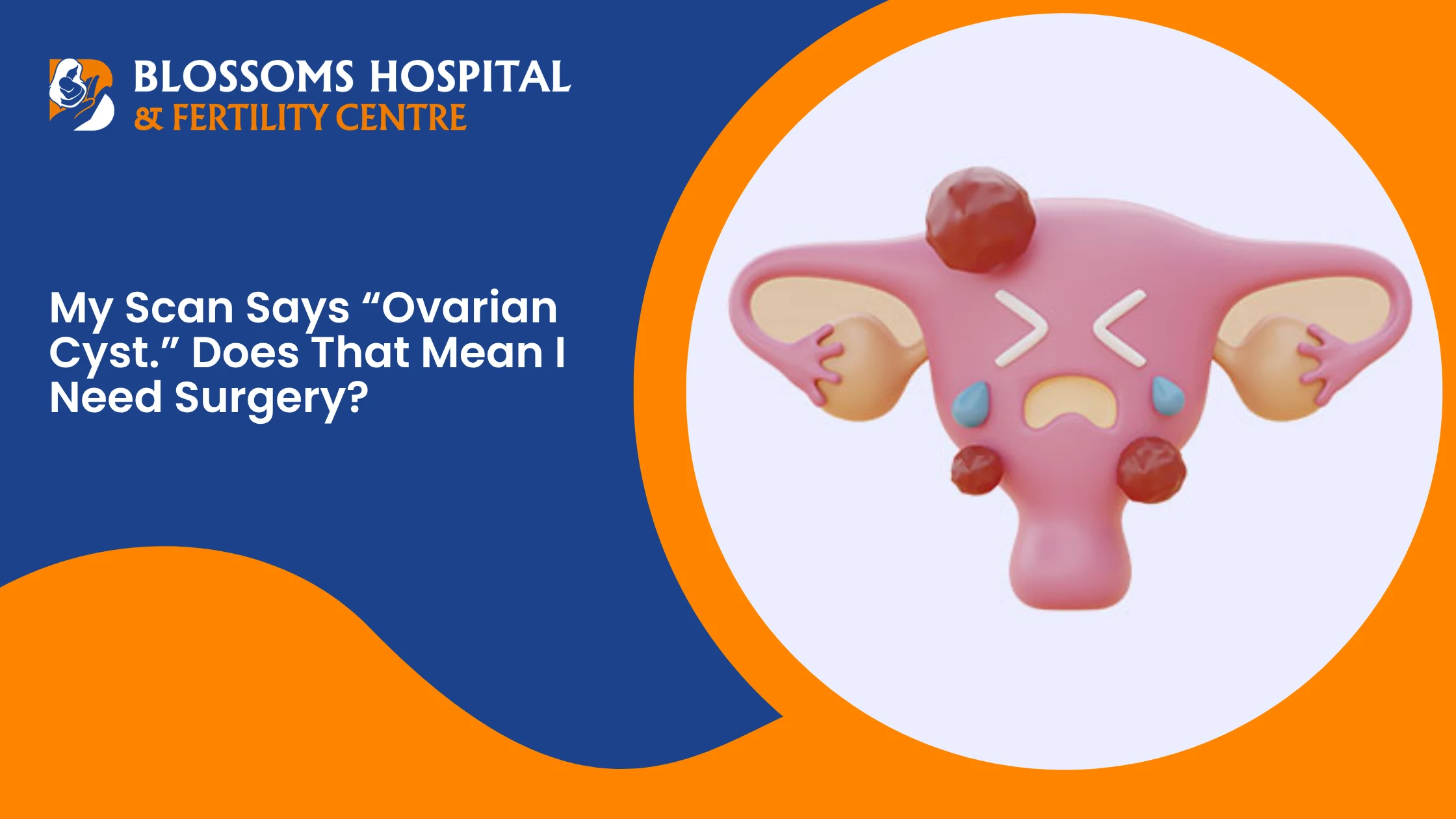
An ovarian cyst is a sac, usually containing fluid, that develops on or within an ovary.
Some cysts develop as part of the menstrual cycle. These are called functional cysts. They commonly resolve without treatment.
Others have different origins and need a different assessment. The word “cyst” alone does not tell you which type you have.
This is why an internet explanation may not match your report.
You may be reading about a completely different finding in someone of a different age, with different symptoms.
Before trying to decide what the cyst means, ask your gynecologist to explain the actual description.
Not just its name.
The Measurement Is Only Part of the Conversation
It is tempting to focus on one number.
“How many centimetres is it?”
That measurement matters, but it does not stand alone.
Your doctor also considers whether the cyst looks simple or more complex, whether it is causing symptoms and whether you have reached menopause. These factors influence whether further assessment, observation or treatment is appropriate.
A useful appointment question is:
“What about my scan makes you recommend this next step?”
That gives you more information than comparing your measurement with someone else’s.
Bring the complete report, rather than only a photograph of the line containing the cyst’s size. If you have previous scans, bring those too.
You do not need to interpret the images yourself. You need your medical team to explain how the information fits together.
“I Don’t Have Pain. How Was It Found?”
Some ovarian cysts are discovered incidentally during an examination or scan performed for another reason.
Not having pain does not make the report incorrect. Equally, finding a cyst does not automatically explain every symptom you have.
Perhaps the scan was arranged because of abdominal discomfort. Perhaps you were being assessed for another gynecological concern.
Ask:
“Is this likely to explain why I came in, or is it a separate finding?”
That distinction can help keep the consultation focused.
Otherwise, it is easy to start attributing every tired day, digestive complaint or change in your cycle to one phrase on the report.
Tell your doctor what you have actually noticed. Let the assessment establish what may be connected.
What Does “Simple” or “Complex” Mean?
These are descriptions of how a cyst appears on imaging.
A simple cyst generally has a thin wall and contains fluid. A complex cyst may contain blood, thicker material or solid areas.
“Complex” is not another word for cancer. It means the appearance needs to be considered more carefully in context.
You do not have to memorise every imaging term.
Instead, ask the doctor to translate the important parts:
- What does the description suggest?
- Is anything uncertain?
- What information would clarify that uncertainty?
- What should I do next?
A clear explanation should leave you understanding the plan, even if you cannot repeat the technical wording.
When Monitoring Is a Reasonable Next Step
For selected cysts, your doctor may recommend observation rather than immediate treatment. A repeat ultrasound may be arranged if needed.
Monitoring can help establish whether the finding resolves or changes. It is not the same as ignoring it.
However, “wait and see” can feel incomplete when you are the person doing the waiting.
Ask for a practical plan:
“When should I return?”
“Will I need another scan?”
“Who should review the result?”
“What symptoms mean I should come back sooner?”
Write down the answers before leaving.
If follow-up is recommended, put it in your calendar. If no further follow-up is needed, ask the doctor to explain why.
The goal is not to arrange repeated tests for reassurance alone. It is to understand what follow-up is appropriate for your finding.
What If Surgery Is Recommended?
Some cysts warrant surgery because of their features, persistence, symptoms or concern about their nature.
When surgery is being considered, the discussion should cover why it is recommended and which approach fits your situation. Keyhole surgery may be appropriate in some cases; others require a different approach.
Before agreeing to a procedure, you can ask:
- What is the main reason for recommending surgery?
- Are there reasonable alternatives?
- What are the benefits and risks for me?
- What exactly do you expect to remove?
- Could the plan change during the operation?
- What will follow-up involve?
These are not difficult or disrespectful questions.
They are part of understanding your care.
If you feel overwhelmed, say so. Ask for the explanation again in simpler language, or bring someone you trust to help remember the discussion.
Will a Cyst Affect Future Pregnancy?
A cyst finding alone does not mean you cannot become pregnant.
If surgery is needed, preserving ovarian tissue may be possible, but the operative plan and potential effects depend on the individual situation. Do not assume that either the cyst or its removal has no implications for you.
Tell your gynecologist if you hope to have children, even if pregnancy is not an immediate plan.
You might say:
“I’m not trying now, but future pregnancy matters to me. How does that affect our discussion?”
This gives your doctor an opportunity to explain the options in relation to your priorities.
You do not need to turn the appointment into a general fertility investigation. Keep the question connected to the cyst and any proposed treatment.
What About Cancer?
This is often the question people hesitate to ask.
Most ovarian cysts are non-cancerous, but the individual finding still needs assessment. Menopausal status and scan features matter.
If blood tests are recommended, remember that an abnormal result does not necessarily establish cancer. Some non-cancerous conditions can also affect these results.
Ask directly:
“Is there anything about my result that concerns you?”
“What does this test help us understand?”
You deserve a balanced answer.
Neither “every cyst is dangerous” nor “all cysts are harmless” is a useful substitute for interpreting your own report.
If specialist assessment is advised, ask what the referral is intended to clarify.
How to Prepare for Your Appointment
A little preparation can make the consultation more useful.
Bring your report and any earlier relevant records. Make a short note of what led to the scan, what has changed and what you most want answered.
For example:
“The discomfort began three weeks ago.”
“It comes and goes.”
“I’m mainly worried about whether an operation is necessary.”
You do not need a perfect symptom diary. A few clear observations are enough to begin.
List current medicines and mention relevant previous surgery or family history when asked.
If a friend has suggested a treatment, write down your question rather than starting it yourself.
It is fine to say:
“Someone recommended this. Is there any reason it would be appropriate for me?”
That keeps advice from becoming an unreviewed treatment decision.
When You Should Not Wait for Follow-Up
Sudden, severe pelvic pain needs urgent medical assessment. Abdominal pain accompanied by nausea or vomiting also warrants urgent attention.
These symptoms can have several causes and should not be managed by assuming they are simply your known cyst.
For ongoing, less urgent symptoms, arrange a review rather than repeatedly searching for reassurance online.
If your symptoms change while you are being monitored, contact your medical team for advice about whether the plan needs reassessment.
A follow-up date is not a reason to postpone care when something significant changes.
Practical Takeaways
- An ovarian cyst does not automatically mean surgery.
- The whole report matters—not just one measurement.
- Ask whether the finding explains your symptoms.
- Understand any monitoring plan and when to return.
- Discuss future pregnancy priorities before treatment decisions.
- Seek urgent assessment for sudden severe pain or pain with vomiting.
A Report Should Start a Conversation, Not End It
Seeing an unfamiliar finding can leave you feeling that a decision has already been made.
Usually, the next useful step is simpler: understand what was found and what your doctor recommends for you.
You do not need to arrive with a diagnosis or a preferred operation.
Bring the report. Bring your questions.
For women in Bandlaguda Jagir, Hyderabad, Blossoms Hospital & Fertility Centre provides gynecology consultations and lists laparoscopic treatment for ovarian cysts. You can discuss whether your finding needs observation, further assessment or a treatment conversation.
Blossoms Hospital & Fertility Centre
Bandlaguda Jagir, Hyderabad
📞 +91 99803 63399
🌐 blossomsfertility.com
Frequently Asked Questions
1. Can I wait until I have spoken to the doctor before searching for treatment options?
Yes, a report-review appointment is a sensible place to begin if you are otherwise well. Ask your doctor to explain the finding before comparing treatments. Urgent symptoms, however, should be assessed without waiting for that appointment.
2. Should I bring previous scans even if they were done elsewhere?
Yes. Bring the reports and available images so the reviewing doctor can decide whether comparison is useful. Include the dates. Avoid relying on your own comparison of measurements without the complete reports being reviewed.
3. Why does my friend have a different follow-up plan?
You may have different scan findings, symptoms or clinical circumstances. Ask why your plan suits your case rather than using someone else’s schedule as a benchmark. A different plan does not, by itself, mean either person is receiving inadequate care.
4. Is a repeat scan a sign that the first scan was wrong?
Not necessarily. A repeat scan may be intended to check what happens over time. Ask what the next scan is expected to clarify and who will review it. That makes the purpose of follow-up easier to understand.
5. Can I take someone with me to discuss surgery?
You can ask the hospital about bringing a trusted person. They may help you remember questions and explanations. Your own preferences and consent remain central; accompanying someone should support the conversation, not replace your participation.
6. What if I do not understand the proposed operation?
Ask the surgeon to describe the intended procedure in everyday language. Clarify what would be removed, why, and which uncertainties remain. You can request a written summary of the plan so you have time to review your questions.
7. Should I mention future pregnancy if I am not married or trying yet?
Yes, if it matters to you. Reproductive goals are relevant personal priorities, not something you need to justify. You can ask how the proposed management fits those goals without making assumptions about your future circumstances.
8. What should I do if pain becomes suddenly severe?
Seek urgent medical assessment rather than waiting for the next scheduled review. Tell the treating team about the cyst finding and bring the report if readily available, but do not delay getting help while searching for documents.